Most cycles continue for one reason.
They are invisible.
Not invisible in the sense that nothing happens. The behaviors are visible. The reactions are visible. The outcomes are visible.
What remains hidden is the pattern.
A person may repeat the same response for years without realizing that the response itself has become automatic. A situation appears new each time it occurs, even though the structure surrounding it has already repeated many times.
Cycles survive on this invisibility.
They continue because the people inside them interpret each moment individually instead of seeing the pattern connecting them.
This is why recognition matters.
Recognition is rarely dramatic.
It is not a sudden declaration or a moment of anger that interrupts everything at once. Recognition usually arrives quietly.
A person notices something.
They see the same response appearing again. They see the same tension developing in a familiar situation. They begin to recognize that the outcome was predictable long before it happened.
At first this realization can feel uncomfortable.
Patterns that once seemed unavoidable begin to look structured. Behavior that once felt justified begins to look repetitive.
This moment can feel unsettling.
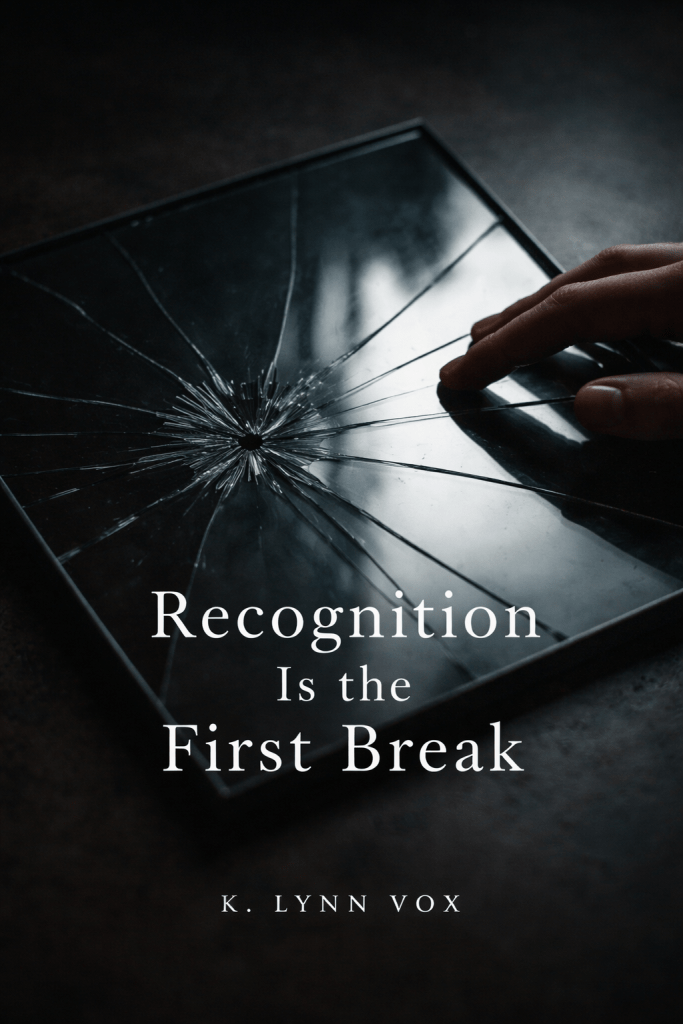
But it is also the first break.
Because once a pattern becomes visible, it can no longer operate the same way.
Even if the behavior repeats again, the person now sees it.
The moment is no longer automatic.
Recognition introduces space.
A reaction that once happened instantly now pauses. A familiar response becomes something that can be observed before it is repeated.
That pause changes the direction of the cycle.
Cycles depend on repetition.
They strengthen every time the same response occurs under the same conditions. When recognition appears, repetition begins to weaken.
Not because the cycle disappears immediately.
But because the person inside the cycle is now watching it happen.
Awareness interrupts invisibility.
From that moment forward, the pattern has lost its strongest protection.
Recognition does not require perfection.
The pattern may repeat again many times. Habit and familiarity do not disappear instantly.
But each time the cycle appears, recognition returns.
The person sees it sooner.
They notice the signals earlier. The tension, the reaction, the predictable outcome—all of it becomes easier to identify before the cycle completes itself.
Over time this awareness grows stronger.
The pause becomes longer.
Within that pause, a different response becomes possible.
A reaction softens.
A boundary appears.
A decision changes direction.
The cycle begins losing momentum.
From the outside, people may believe the change happened suddenly.
They may think the person simply decided one day to behave differently.
But real change almost never begins with behavior.
It begins with recognition.
Recognition is the moment someone finally sees the pattern clearly enough that it can no longer continue unnoticed.
And once a cycle can no longer continue unnoticed, it has already begun to weaken.
This is why recognition matters so much.
It is not the end of the cycle.
But it is the first break.
—
K. Lynn Vox
 K. Lynn Vox